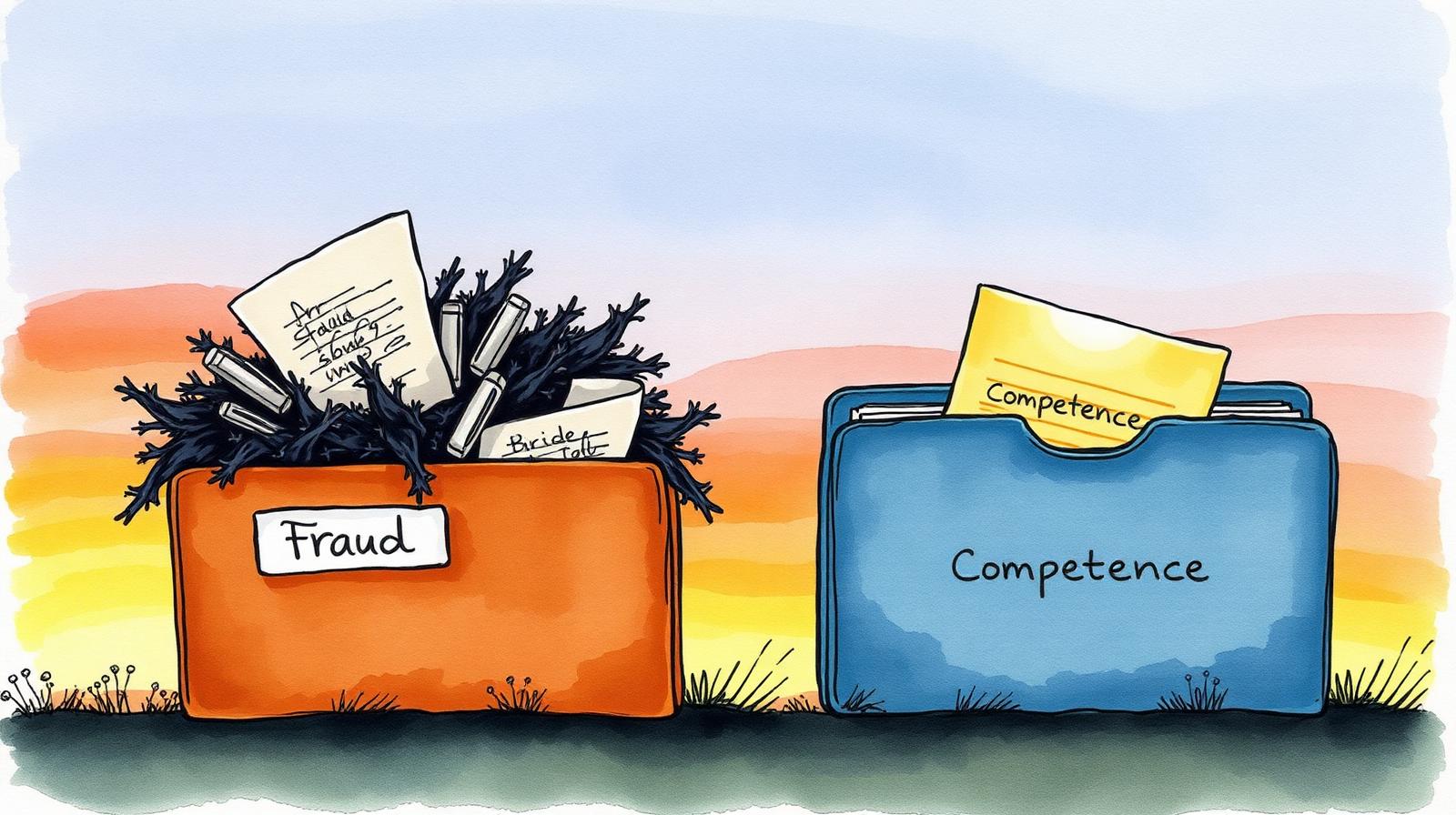

For late-diagnosed women with ADHD, imposter syndrome doesn’t start when someone questions your competence. It starts the moment you build a version of yourself that can pass — and watch the world reward her instead of you.
I had a brilliant job. A good position. I was, I hope, well respected. But I genuinely don’t know how I got there. I couldn’t understand it then, and every day after that was about keeping up with what I thought they thought I was.
Double-checking, triple-checking, things that everyone else just did once. Building entire systems of scaffolding in secret just to appear marginally functional. Working stupid hours to prove I belonged in that same room with everyone else.
And the masking. The systematic, automatic, exhausting process of suppressing every neurodivergent trait I had. The forgetfulness, the disorganisation, the overwhelm. Until hiding it became so habitual that I didn’t even know I was doing it anymore.
And here’s where it gets really cruel. When you mask that well, you get praise for the masked performance. You’re told you’re capable, you’re impressive, you’re holding it all together. And every single compliment lands wrong. Because the real you wasn’t being evaluated. They were applauding a character you built out of pure desperation.
The classic imposter syndrome story is about someone who secretly fears being exposed as less than they appear. But for late-diagnosed ADHD women, the story is different. We didn’t fear being found out. We already believed we were less. And we couldn’t understand why nobody else could see what was so obvious to us.
ADHD Summary
ADHD masking is the learned suppression of neurodivergent traits to meet neurotypical expectations. For women, the mask tends to form earlier, fit tighter, and last decades longer — because the traits girls are socialised to develop (people-pleasing, emotional monitoring, quiet compliance) double as camouflage for ADHD. The result: a fraud feeling that is not a distortion but a logical conclusion from the evidence your brain has been collecting.
Key facts
- Adults with ADHD score significantly higher on social camouflaging than neurotypical peers (van der Putten et al., 2024, Autism Research, N=315)
- Social camouflaging is the mediating variable between ADHD symptoms and imposter feelings (Hall, Stuckey & Berman, 2026, Behavioral Sciences, N=500)
- Higher social camouflaging in women with ADHD correlates with lower life satisfaction and higher depressive symptoms (Wicherkiewicz & Gambin, 2024, J Autism Dev Disord, N=329 women)
- In a 2025 study of 1,056 adults with ADHD and/or autism, 83% scored high for masking in work or school contexts compared with just 21% around people with the same diagnosis (Frontiers in Psychiatry, 2025)
- 54.2% of women with ADHD experience debilitating perimenopausal symptoms, peaking at ages 35 to 39 — often the point where masking collapses (Jakobsdóttir Smári et al., 2025, European Psychiatry, N=5,392)
- As of December 2025, an estimated 2.76 million people were waiting for ADHD assessment in England alone (House of Commons Library, 2026)
What this means for you: If you’ve spent years performing a version of yourself that looks competent, and every compliment feels like it was meant for someone else, that’s not a confidence problem. It’s what happens when an ADHD brain masks for decades without knowing why.
Why does masking make every achievement feel like it belongs to someone else?
Masking is the learned suppression of ADHD traits to meet neurotypical expectations. When the self that gets praised at work is not the self who collapses at home afterwards, every compliment becomes evidence that the performance is working — not evidence that you are enough.
There’s a useful distinction here. Coping is using a tool to get a job done. Masking is hiding the fact that you needed the tool in the first place.
Setting reminders, writing everything down, building post-it systems, sending follow-up emails so there’s always a paper trail: that’s coping. Making sure nobody ever sees you do any of it, and accepting praise for being “naturally organised” when the reality is anything but: that’s masking.
And once the masking is working, a feedback loop kicks in. The better you mask, the more evidence your brain collects that the fraud is succeeding. Every promotion reinforces the performance, not the person. Every compliment lands on the character you built, not on you.
People were praising my mask, they were not praising the real messy me, that I was trying to hide. But that messy me was the most desperate for praise.
This isn’t a distortion. It’s the logical conclusion from the evidence your brain has been collecting for decades. Research published in 2026 confirmed what late-diagnosed women have been saying for years: social camouflaging is the mediating variable between ADHD symptoms and imposter feelings (Hall, Stuckey & Berman, 2026). The mask is not a side effect. It is the mechanism.
Source: Frontiers in Psychiatry, 2025 (N=1,056)
What does ADHD masking actually look like in women?
In women, ADHD masking tends toward people-pleasing, emotional labour, over-preparation, and building invisible scaffolding systems. Girls are socialised to self-monitor and suppress disruption, which means the mask forms earlier, fits tighter, and lasts decades longer before anyone notices it.
Masking can look like being polite, prepared, easy-going, funny, composed or efficient. But internally, it can feel like running a live social translation programme all day: monitoring your face, tone, body, volume, timing, reactions, eye contact, emotions, pace, interruptions and perceived likability. By the time the mask comes off, there may be no energy left for eating, tidying, replying to messages or being present with the people you love.
Retail mode except it’s just for a normal interaction and then when I get home I’m so exhausted I just want to lay down and cry.
The work-self/home-self split comes up again and again. Rockstar at work, unable to cook dinner. Praised for being calm and reliable, privately falling apart. Hyper-competent in meetings, unable to open post at home. A 2024 study of 329 women with ADHD found that higher social camouflaging was significantly associated with lower life satisfaction and higher depressive symptoms (Wicherkiewicz & Gambin, 2024). A 2025 study of over 1,000 adults found that 83% scored high for masking in work or school settings, compared with just 21% around people with the same diagnosis (Frontiers in Psychiatry, 2025, N=1,056). The performance is not constant. It is context-dependent. And the contexts that demand it most are the ones where you spend most of your waking hours.
Girls learn early that being quiet, compliant, and emotionally attuned gets rewarded. For girls with ADHD, those same traits double as camouflage. Research on how ADHD shows up in girls found that their symptoms tend to be more socially oriented and internalised than current diagnostic criteria capture, and that masking and compensation were universal themes (Williams et al., 2025). The mask doesn’t look like effort. It looks like personality. And that’s why it lasts so long.
Source: Jakobsdóttir Smári et al., 2025, European Psychiatry (N=5,392)
For many women, the point where the mask finally cracks is perimenopause. Hormonal shifts strip away compensation that held for decades. This is often the trigger for late diagnosis: not because the ADHD got worse, but because the scaffolding that hid it finally gave way.
- Masking is hiding the fact you needed the tool, not using the tool itself — and it turns every compliment into evidence the performance is working
- 83% of adults with ADHD scored high for masking at work, compared with 21% around people with the same diagnosis
- Women’s ADHD masking tends toward people-pleasing, over-preparation, and invisible scaffolding systems that run all day
- For many women, perimenopause is the point where decades of compensation finally crack
How does masking become who you think you are?
When masking starts in childhood, before you have a word for what you are doing, the performance becomes the identity. Psychodynamic theory calls this the false self: a compliant façade built to survive environments that could not meet you as you were. It feels real because it is all you have ever known.
Most late-diagnosed women did not choose to mask. They were corrected into it. They were called too loud, too much, too annoying, too disorganised, too emotional. And they adapted. The mask was not a personality flaw. It was a protection strategy. The problem is that a protection strategy can become so automatic that it starts to feel like the only version of the self that exists. If you recognise the weight of years spent believing something was fundamentally wrong with you, the companion piece on shame, self-blame, and why you were never the problem goes deeper into that territory.
Donald Winnicott, the paediatrician and psychoanalyst, described this as the false self: a compliant façade that forms when the environment cannot reliably meet the child as they are. The child learns to suppress their spontaneous gestures and replace them with what the environment rewards. It’s a theoretical framework, not a tested model for ADHD specifically, but the fit is striking. When you’ve spent your whole life performing acceptability, the question “who am I really?” is not philosophical. It’s urgent.
Everyone always tells me I’m calm and quiet but I’m neither of those. And no one will ever know. I’m a messy, all-over-the-place hyper extrovert that is hidden behind a mask made out of anxiety, people pleasing and perfectionism.
That sentence captures something the clinical literature calls “identity disturbance” but which feels more like a series of unanswerable questions.
Was I calm, or was I frozen? Was I easy-going, or was I afraid to have needs? Was I organised, or was I terrified of being exposed? Was I sociable, or was I performing likability? Was I successful, or was I surviving?
The mask does not just hide symptoms. Over decades, it replaces the self. And when you finally get a diagnosis, the first thing many women discover is not relief. It’s that they don’t know who is underneath.
Why doesn't getting diagnosed fix it?
20s
40s
Diagnosis names the pattern but does not undo decades of performing. Many women describe a grief process after diagnosis: mourning the life they might have lived, the relationships that suffered, the years spent calling themselves lazy or stupid. The mask does not fall off because you finally see it. It has to be carefully, selectively removed.
There’s a version of the diagnosis story that goes: you find out you have ADHD, you understand yourself better, you move forward. That version exists. But alongside it, for many late-diagnosed women, there is a grief that nobody warns you about.
Who am I now and who would I have ever been if I had never had to mask is honestly the primary thing driving my therapy regarding ADHD.
— 58-year-old woman, recently diagnosed
Andersen’s 2025 theoretical paper argued that adapting to an adult ADHD diagnosis is a grief-related process best understood through the Dual Process Model: oscillating between loss-orientation (mourning what was missed) and restoration-orientation (rebuilding a life that fits). It’s not linear. It’s not quick. And it’s not a sign that something has gone wrong.
Qualitative research with UK women diagnosed in adulthood found that diagnosis was often empowering but “tinged with sadness due to previous experiences which were painful and traumatic” (Morgan, 2024). The women described internalised ableism, years of misdiagnosis with anxiety and depression, and minimal post-diagnostic support. They didn’t just grieve for missed opportunities. They grieved for the self who was forced to stay hidden. If you’re in the middle of that grief right now, the piece on mourning the life you could have had is written for exactly where you are.
As of December 2025, an estimated 2.76 million people were waiting for ADHD assessment in England alone (House of Commons Library, 2026). The system gives you a label. Sometimes medication. But no map for what comes next. That gap between diagnosis and practical support is exactly where the grief lives, and exactly where coaching begins.
If the question driving your post-diagnosis experience is less “do I really have ADHD?” and more “who am I now that I know?”, you’re not broken. You’re in the middle of a process that most late-diagnosed women go through, and you don’t have to do it alone.
What actually helps when the mask is all you have ever known?
Unmasking is not a single dramatic reveal. It is a gradual, selective process of choosing where and when to let the performance drop. Emerging research points to self-compassion, psychological flexibility, and neurodiversity-affirming coaching as the most promising approaches — not because they remove the mask, but because they build something real underneath it.
For many late-diagnosed women, the answer starts with one person, one room, one conversation where the performance can drop, even slightly, and the world doesn’t end.
You don’t need a formal diagnosis to start this work. If you’re on a waiting list, or suspecting but not yet assessed, coaching is not gated behind a clinical label. The system has a multi-year queue. You don’t have to wait.
The thing you did to survive is the thing that makes you feel like a fraud. That is not your fault, and it is not the end of the story. The mask was never the real you. It was the version of you the world required when nobody knew what you actually needed.
Now you know. And you get to choose what happens next.
For the full picture of how ADHD and imposter syndrome feed each other, and the six mechanisms driving it, read the flagship article: ADHD and Imposter Syndrome.
Sources
- Andersen, L. (2025). “From ADHD Diagnosis to Meaning: Does Grief Theory Enhance Our Understanding of Narrative Reconstruction?” Brain Sciences, 15(10), 1045
- Beaton, D.M., Sirois, F. & Milne, E. (2022). “The role of self-compassion in the mental health of adults with ADHD,” Journal of Clinical Psychology, 78(12), 2497–2513
- Hall, C.L., Stuckey, L. & Berman, R. (2026). “Attention-Deficit/Hyperactivity Disorder, Imposter Phenomenon, and Identity Distress: The Mediating Indirect Effects of Self-Esteem, Social Camouflaging, and Social Media Connections,” Behavioral Sciences, 16(2), 213
- House of Commons Library (2026). FAQ: ADHD statistics (England). Research briefing CBP-10551
- Jakobsdóttir Smári, U. et al. (2025). “Perimenopausal symptoms in women with and without ADHD: A population-based cohort study,” European Psychiatry, 68(1), e133
- Morgan, J. (2024). “Exploring women’s experiences of diagnosis of ADHD in adulthood: a qualitative study,” Advances in Mental Health, 22(3), 575–589
- Pahnke, J. et al. (2023). “Acceptance and commitment therapy for autistic adults: A randomized controlled pilot study in a psychiatric outpatient setting,” Autism (Sage). PMC: PMC10291362
- Pearson, A. & Rose, K. (2021). “A Conceptual Analysis of Autistic Masking: Understanding the Narrative of Stigma and the Illusion of Choice,” Autism in Adulthood, 3(1), 52–60
- van der Putten, W.J. et al. (2024). “Is camouflaging unique for autism? A comparison of camouflaging between adults with autism and ADHD,” Autism Research, 17(4), 812–823
- Wicherkiewicz, A. & Gambin, M. (2024). “Relations Between Social Camouflaging, Life Satisfaction, and Depression Among Polish Women with ADHD,” Journal of Autism and Developmental Disorders
- Wills, V. & Chakraborty, R. (2026). “A Qualitative Study on the Experiences of Adult Females with Late Diagnosis of ASD and ADHD in the UK,” Healthcare, 14(2), 209
- Williams, R. et al. (2025). “Reflections on the manifestation of attention-deficit hyperactivity disorder in girls from young adults with lived experiences: a qualitative study,” The British Journal of Psychiatry
- Winnicott, D.W. (1965). The Maturational Processes and the Facilitating Environment. London: Hogarth Press
If this resonated with you…
This is the work I do in 1:1 coaching — moving you from self-blame to self-understanding, and from treading water to finally living YourADHD.Life.
The Your SHINE Journey programme is 6 months of deep, personalised coaching for late-diagnosed women who are ready to stop managing and start living. No scripts, no one-size-fits-all. Just real work, built around your brain.

Nishia Wadhwani
ADHD Coach
ADHD Coach and founder of YourADHD.Life. Late-diagnosed herself, she works with women navigating the reality of ADHD in midlife — the career, the relationships, the identity shifts, and the "what now" that nobody prepared them for.
Learn more about me →