
Not long ago Phil Le Gros and I sat in front of cameras and talked to a live audience about ADHD and imposter syndrome. It got extraordinary feedback, nothing like what we had expected. People told us it changed how they saw themselves. Someone I respect went out of their way to send me a few very specific, warm compliments afterwards.
Within days, the only things my brain could access were seven things that went wrong. Every stumble in high definition. Every piece of praise already dissolving.
The talk was about this exact mechanism.
ADHD coaches call it achievement amnesia. Researchers call it a failure to take in your own success. Whatever you call it, it explains why the fraud feeling never goes away no matter how much you achieve. Here's the neurological mechanism, and why most of the advice you've been given about it is wrong.
ADHD Summary
Achievement amnesia is what happens when your ADHD working memory won't build a stable record of your own competence. Each new challenge feels like starting from zero. You have succeeded before but your brain just can't access the proof.
Key facts
- Your brain holds onto threats more strongly than wins (Vrijsen et al., 2018)
- Praise lands in the moment but doesn't build a lasting sense of "I can do this" (Fitzgerald & Tripp, 2024)
- No published study has ever tested a treatment for imposter syndrome - not even one (Bravata et al., 2020)
- The standard advice - wins journals, affirmations - relies on the exact skills ADHD disrupts
- Your brain can use positive evidence when someone shows it to you - it just can't find it on its own (Atkinson et al., 2025)
What this means for you: The problem isn't your attitude, your effort, or your gratitude. It's a gap between what your brain stores and what it can find again. If you're wondering where that gap is showing up in your life, the ADHD Wheel of Life can help you see the full picture.
Why can you do something brilliantly one day and feel incompetent the next day?
Working memory in ADHD does more than make you forget your keys. It shapes how you see yourself. Your brain holds onto information selectively, and it's biased toward what went wrong. Successes dissolve. Failures pile up.
Think of working memory as your brain's active desktop. It's the ability to hold and use information in the moment. It decides what to keep and what gets stored long-term.
In ADHD, that desktop is simply smaller and therefore has less space. But it's not just about capacity. Research by Atkinson et al. (2025, Lancaster and Leeds universities) found something important: adults with ADHD can hold onto valuable information when someone tells them it matters. The problem is doing it yourself. Left on its own, your brain doesn't flag your successes as worth remembering.
What it does flag is threat. Vrijsen et al. (2018) studied 675 adults and found that this negative memory bias is one of the things connecting ADHD symptoms to real-world problems. Your brain records what went wrong, what might go wrong, and what has gone wrong before. The wins get a brief moment on the desktop before being cleared away.
ADHD coaches call this achievement amnesia. It's the everyday name for what researchers Clance and Imes described back in 1978: "the pattern of succeeding but never actually believing your own success". Hall, Stuckey and Berman (2026) recently confirmed a direct link between ADHD, the imposter feeling, and struggles with identity.
You're not starting from zero because you haven't achieved anything. You're starting from zero because your brain can't carry the evidence forward.
"You're not starting from zero because you haven't achieved anything. You're starting from zero because your brain can't carry the evidence forward."
- Nishia Wadhwani
Why don't compliments stick?
In a neurotypical brain, positive feedback builds into a stable self-image over time. In an ADHD brain, each compliment lands in the moment but doesn't stick. The dopamine system that should turn praise into lasting confidence doesn't finish the job.
When someone without ADHD gets praised, their brain does two things. First, it gives them a hit of dopamine, the feel-good chemical, right when the compliment arrives, exactly as it should. Then, over time, it starts linking that good feeling to the work that earned it. So next time a similar task comes along, the brain already expects success. The praise has become a prediction. This is expected.
In ADHD, that link doesn't form properly. The dopamine fires when the praise arrives, but it doesn't connect to the effort that caused it. Furukawa et al. (2014) saw this in brain scans: less activity when expecting a reward, more activity when receiving one. The brain over-reacts in the moment and under-prepares for next time.
So the compliment lands. You feel it. It might even feel good for an hour or two. But it doesn't become part of how you see yourself. By morning, the feeling has gone and the familiar suspicion is back.
And what fills the space where pride should be? For most people with ADHD, the answer isn't nothingness. It's relief that the thing is over, dread that it has to be done again in the future, shame that it took so long or just the immediate weight of the next time you need to repeat it. Some people describe never being sure what accomplishment is supposed to feel like, because the only feeling they've ever reliably had after finishing something is "thank God that's over." Accomplishment and reward are supposed to be connected. In ADHD, they often aren't.
If you've ever been praised for work done by your masked self, that adds another layer. The compliment wasn't for you. It was for the performance. How masking compounds the fraud feeling is its own story, but underneath, the mechanism is the same.
So far:
- Your working memory holds onto threats and lets go of wins.
- Your dopamine system feels the praise but doesn't store it for next time.
- So each new challenge is faced without any proof that you've done this before.
- This is how your brain works, not a flaw in your character.
How does your brain turn every mistake into proof?
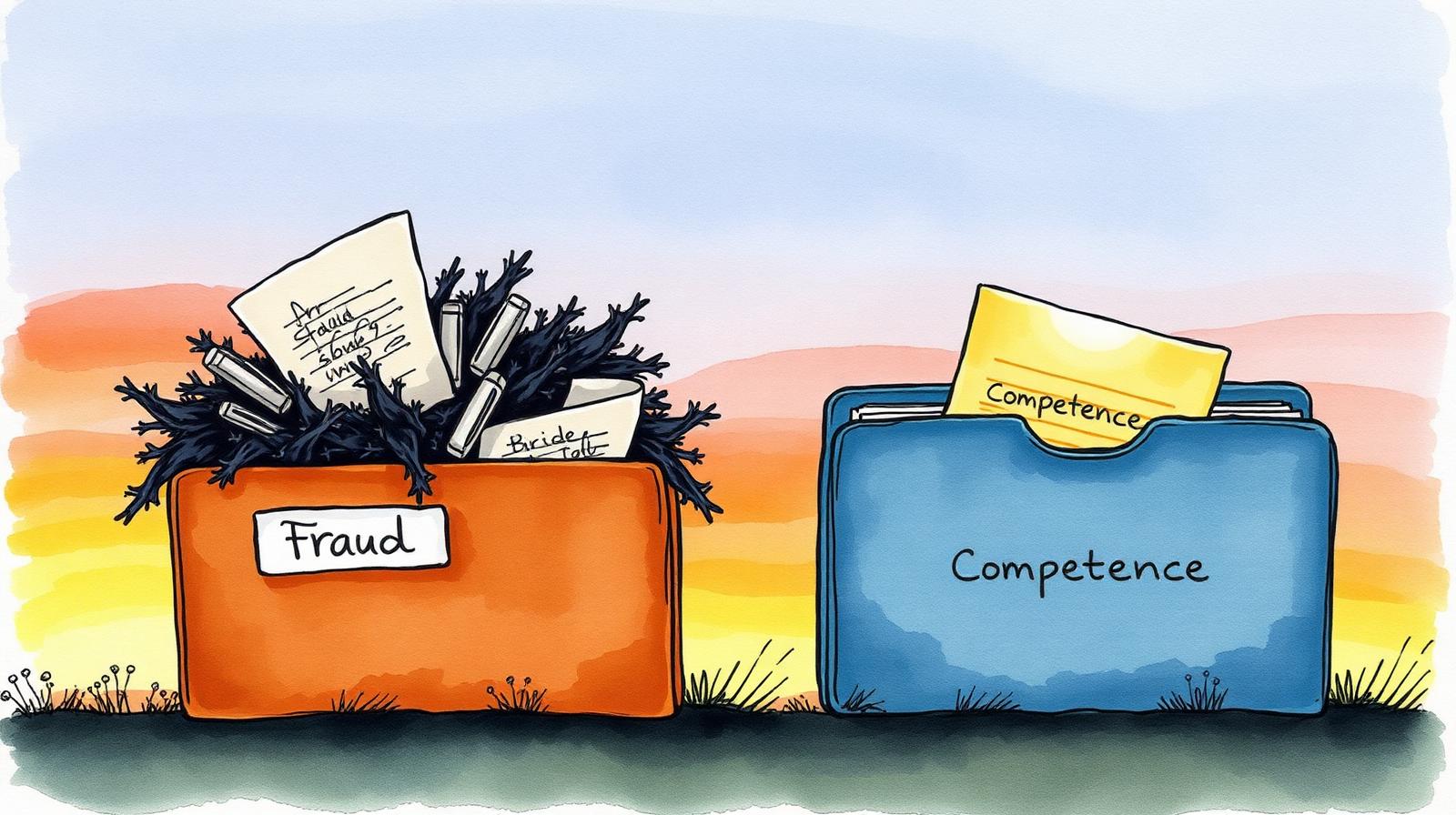
ADHD brains notice what's missing rather than what's done. Every mistake becomes more evidence for the fraud story. Successes never get filed as proof against it. The fraud file grows. The competence file stays empty.
Confirmation bias isn't unique to ADHD. Everyone tends to notice the things that back up what they already believe. But ADHD makes it worse in three ways.
- Bad experiences stick harder. Schubert and Bowker (2019) found that ADHD is linked to fewer positive automatic thoughts and a stronger pull toward the negative. Before you've even had time to think about it, the raw material your brain is working with is already skewed.
- ADHD-related errors are visible in ways that successes aren't. A missed deadline, a forgotten name, a disorganised presentation: people notice those. The three hours you spent building a system to stop it happening again? Nobody sees that. The coping is invisible. The moment the coping fails, it's the loudest thing in the room.
- Late-diagnosed women have spent decades building that fraud file with no explanation for why it kept growing. Women with ADHD are diagnosed, on average, years later than men. That's years of confirming, without any framework, that the problem is you. Holden and Kobayashi-Wood (2025, St Andrews and Durham) found that late-diagnosed women commonly described taking criticism to heart and living with low self-worth driven by guilt and shame. All before they had a name for what was happening.
And even the wins that do happen can get disqualified by how they happened. If the route involved panic, procrastination, an all-nighter, or a last-minute scramble, the result doesn't feel like a clean success. The internal logic goes: I struggled too much for this to count. Anyone else would have done it faster. I didn't plan and succeed, it just sort of happened. The win is real, but the route felt so messy that the brain refuses to file it under "proof I'm capable."
The cycle renews itself. Each new challenge from zero. Each failure added to the file. Each success gone. The internal story stays the same: I got away with it. I got lucky. Next time they'll find it all out. What happens when that cycle plays out in the external world - the promotions, the overwork, the bar that keeps rising - is the focus of the achiever's paradox.
To see how this connects to the bigger imposter syndrome picture, the ADHD and imposter syndrome article maps the whole territory.
Add something true about your competence. Each one becomes a page you can come back to.
Why does standard imposter syndrome advice make it worse?
Most imposter syndrome advice asks you to remember things, start new habits, and reflect on yourself consistently. Those are the exact skills ADHD disrupts. And research suggests that positive affirmations can actually make things worse for people who already feel bad about themselves.
"Keep a wins journal." "Remember your achievements." "Look at how far you've come."
This advice is everywhere. It's well-meaning but it fails ADHD brains for specific reasons.
A wins journal needs you to start the habit, keep it going, and recall what to write. Three demands on skills your brain struggles with already, stacked on top of each other. Laine et al. (2025) studied adults with ADHD and found that the memory problem isn't about using the wrong approach. When given a strategy, ADHD adults use it well. The problem is coming up with one on your own. A journal that depends on you remembering to use it is designed for a brain that doesn't need it.
Affirmations may be worse than useless. Wood, Perunovic and Lee (2009) found that people with low self-worth who repeated positive affirmations actually felt worse afterwards. Affirmations only helped people who already felt good about themselves. Most adults with ADHD don't (Pedersen et al., 2024). Telling them to repeat "I am competent" is likely to widen the gap between the words and what they actually feel.
And here's the part that should make you angry, or at least relieved. Bravata et al. (2020) looked at 62 studies covering over 14,000 people. They found that no published study has ever tested a treatment for imposter syndrome. None. The advice in self-help books and workplace wellbeing programmes has never been tested. Not for anyone, and certainly not for ADHD.
Source: Bravata et al., 2020 - systematic review of 62 studies, 14,161 participants
The problem isn't that you haven't tried hard enough. Everything you've been told to do was designed for a different brain in a world not made for ADHD.
For what actually works instead, practical reframes for ADHD brains covers approaches that work with your brain, not against it.
What actually works for an ADHD brain that can't hold the evidence?
Get the evidence out of your head and into your environment. Move it somewhere it doesn't depend on working memory to show up when you need it. This isn't a feel-good exercise. It's the core recommendation for any brain that struggles with executive function.
Russell Barkley, whose work has shaped ADHD practice for decades, is clear on this. When your brain can't manage things internally, the fix is making them external. Not apps you'll forget to check or journals you'll abandon, things that show up without you having to remember.
Remember the Atkinson finding from earlier? Your brain can use positive evidence when someone points it out. It just can't find it on its own. That's exactly what externalisation does. It puts the evidence somewhere your brain doesn't have to search for it.
Yang et al. (2017, University of Leeds) found the same thing in a different way: children with ADHD remembered information better when they physically acted it out while learning. Make the evidence something you can see, hear, or touch.
For deeper practical work on each of these, including scripts, templates, and specific tools, practical reframes for the fraud feeling goes further.
This is what matters. Not trying harder to remember. Building systems that remember for you.
Achievement amnesia isn't something you fix. It's something you learn to work with once you see what's actually happening. Your brain isn't broken. It's doing what ADHD brains do. Storing threats, ignoring wins and leaving you to face each new task without the evidence you've earned.
The evidence is real, it's just that your brain can't keep hold of it. Once you know that, you can start building around it.
Next time the praise dissolves and the stumbles stay sharp, you'll know what's happening. And you'll know where to look.
To see how achievement amnesia connects to masking, rejection sensitivity, and the wider fraud feeling, read the ADHD and imposter syndrome guide.
Frequently asked questions
Is achievement amnesia a real diagnosis?
No. Achievement amnesia is a lived-experience phrase, not a clinical term. It describes a pattern that overlaps with several recognised ADHD challenges, including working memory deficits, negative memory bias, and difficulties with self-evaluation. Researchers use phrases like "failure to internalise personal success" (Clance & Imes, 1978) and "identity distress" (Hall et al., 2026) to describe similar patterns.
Is achievement amnesia the same as imposter syndrome?
They overlap but they're not the same thing. Imposter syndrome is the broader feeling of being a fraud. Achievement amnesia is one of the mechanisms that drives it - the specific problem of not being able to access your past successes as emotional evidence. You can read more about how they connect in the ADHD and imposter syndrome guide.
Can medication help with achievement amnesia?
Medication can improve working memory and attention, which may help with encoding new experiences. But it doesn't retroactively change how past achievements were stored. The externalisation strategies in this article, like the Fraud Fighter File, work alongside medication because they don't depend on working memory to function.
What's the difference between achievement amnesia and low self-esteem?
Low self-esteem is a general feeling of not being good enough. Achievement amnesia is more specific: you may know, factually, that you've achieved things, but you can't access those achievements as emotional proof when you need them. The CV looks impressive. The self-image says "I have no idea what I'm doing."
Sources
- Atkinson et al. (2025). The Ability to Direct Attention in Working Memory Is Not Impaired in Adults With Symptoms of ADHD. Journal of Attention Disorders.
- Barkley, R. A. (1997/2012). Behavioral Inhibition, Sustained Attention, and Executive Functions. Psychological Bulletin.
- Bravata, D. M. et al. (2020). Prevalence, Predictors, and Treatment of Impostor Syndrome: A Systematic Review. Journal of General Internal Medicine.
- Clance, P. R. & Imes, S. A. (1978). The Imposter Phenomenon in High Achieving Women. Psychotherapy: Theory, Research and Practice.
- Pedersen et al. (2024). Self-Esteem in Adults With ADHD Using the Rosenberg Self-Esteem Scale: A Systematic Review. Journal of Attention Disorders 28(7): 1124-1138.
- Fitzgerald, M. & Tripp, G. (2024). Using Rodent Data to Elucidate Dopaminergic Mechanisms of ADHD.
- Furukawa et al. (2014). Abnormal Striatal BOLD Responses to Reward Anticipation and Reward Delivery in ADHD. PLOS ONE.
- Hall, S., Stuckey, D. & Berman, M. (2026). ADHD, Imposter Phenomenon, and Identity Distress. Behavioral Sciences 16(2):213.
- Holden, J. & Kobayashi-Wood, H. (2025). Adverse Experiences of Women with Undiagnosed ADHD. Scientific Reports 15:20945.
- Laine et al. (2025). The Role of Spontaneous Strategy Use in Verbal Episodic Memory Impairment in Adult ADHD. Journal of Neuropsychology.
- Schubert, T. & Bowker, A. (2019). ADHD and negativity bias in automatic thought patterns.
- Vrijsen et al. (2018). ADHD Symptoms, Stressful Life Events and Negative Memory Bias. ADHD: Attention Deficit and Hyperactivity Disorders.
- Wood, J. V. et al. (2009). Positive Self-Statements: Power for Some, Peril for Others. Psychological Science.
- Yang et al. (2017). Impaired Memory for Instructions in Children with ADHD. Frontiers in Psychology.

Nishia Wadhwani
ADHD Coach
ADHD Coach and founder of YourADHD.Life. Late-diagnosed herself, she works with women navigating the reality of ADHD in midlife — the career, the relationships, the identity shifts, and the "what now" that nobody prepared them for.
Learn more about me →